Taking the Path Less Traveled

Wild Goose is a 43-foot sailboat and, like her namesake, she has sleek lines and a tough resolve. We traveled 40,000 miles over a six-year period on this boat and amassed a lifetime of experiences. From the people to the places, these are the tales that make traveling on a sailboat worthy. In this blog I'll tell you about our travels on Wild Goose; about the people, the places, the storms, the icebergs, the whales and the pirates. I'll include photos and stories like Violetta, our guide in the jungles of Venezuela. The most beautiful woman I've ever seen who wore short cut-off jeans and sported a 10-inch hunting knife strapped to her leg. With humor, a little advice and some insight, I hope these tales will make you want create adventures of your own.

Sunday, October 23, 2011

Conch, Beer and......a Hurricane!

There’s been a lot of publicity this year about hurricanes especially after Irene blew through the Bahamas, crossed North Carolina Outer Banks and terrorized New York City. Many people ask if we ever encountered a big storm while we cruised on Wild Goose. Yes, we endured a hurricane in the Bahamas. “Whoa-what was it like?” they ask. Well, let’s start from the beginning.

Yum! Fresh conch from the shell
Snorkeling in the clear Bahamas water
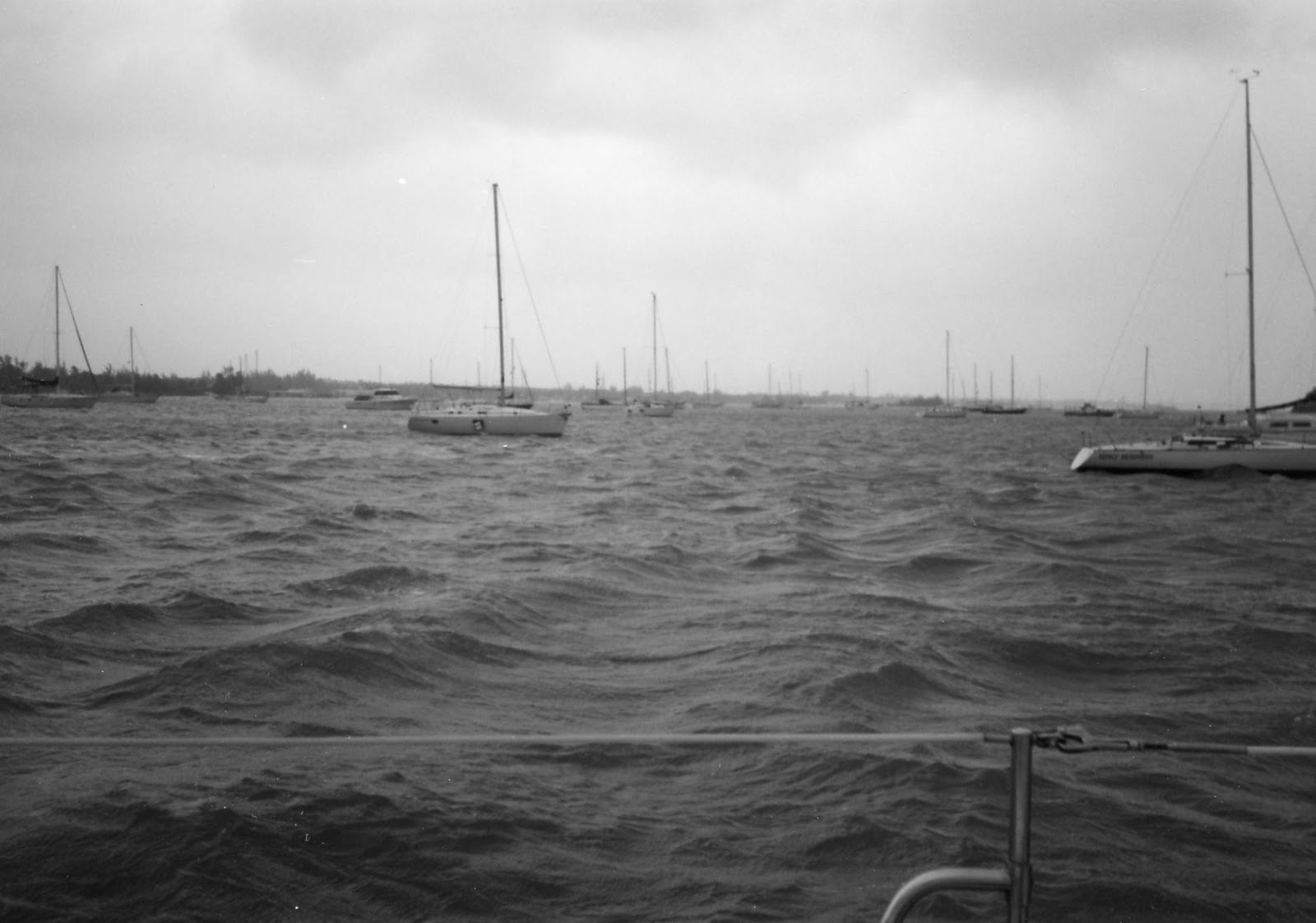
We had only been cruising about three months when we picked up both of our children in Key West, Florida and headed for the Bahamas. Tracy brought along her cat, Samantha, who never really warmed up to boat life. It was to be an exciting summer vacation from college, although it was a little heavy on the excitement end. Official hurricane season is June 1st until November 30th with the majority of the hurricanes in the Bahamas occurring in August and September. With that in mind, we sailed across to the Berry Islands, a stirrup-shaped chain of tiny islands, called cays and pronounced “keys”, on the northeastern edge of the Great Bahamas Bank. We leisurely fished and snorkeled our way through the islands learning about the Bahamian culture and their relaxed way of life.

Weather looks great---now
Although the weather was fantastic where we were sailing, forecasts were looking a little grim. An early July tropical storm brewed out in the Atlantic Ocean. We made our way to one of the few somewhat safe harbors in the Bahamas, Marsh Harbor, in the Abaco Islands. 

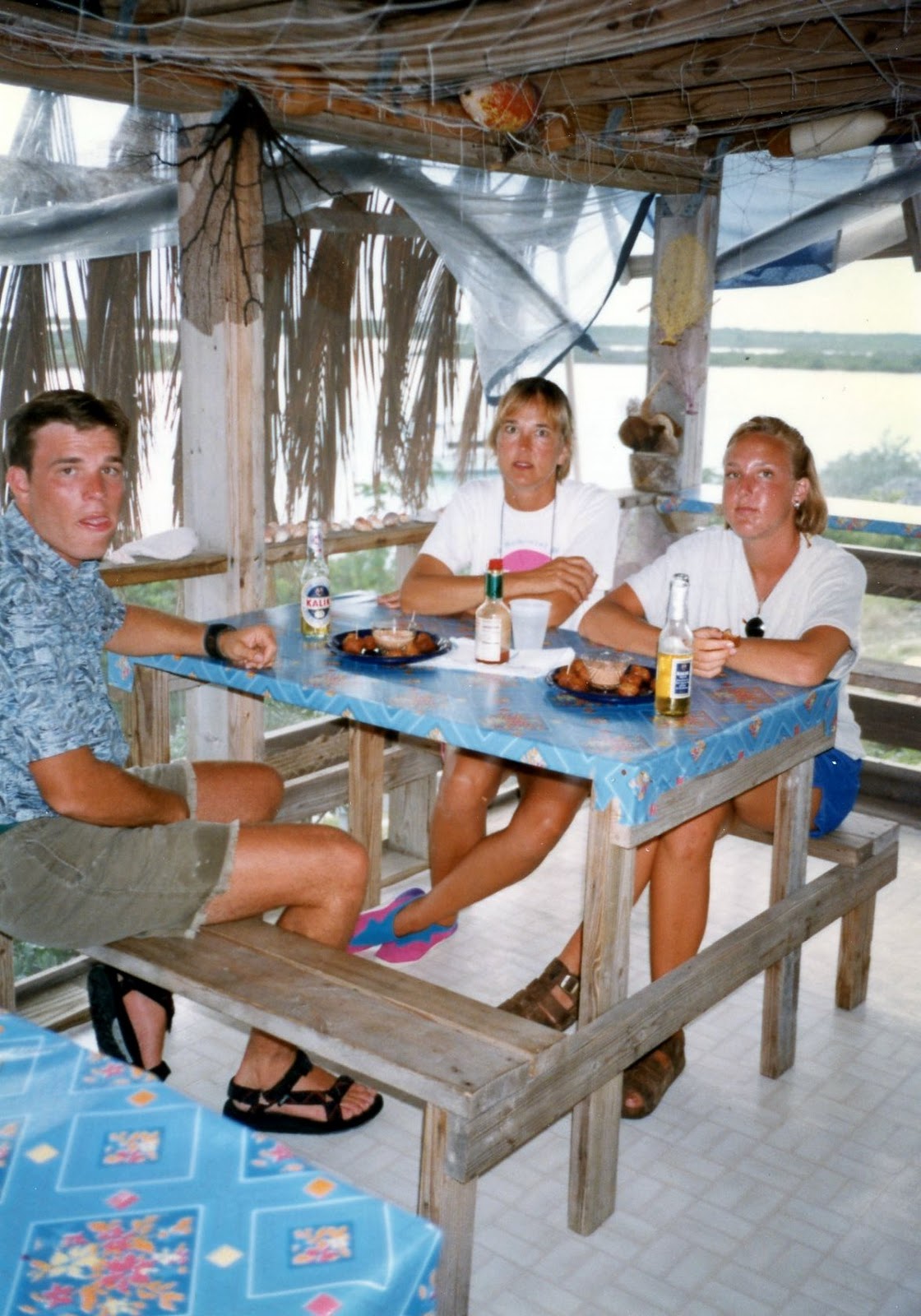
Great hangout-Sapodilly's Bar & Grill also called Dilly's
Our first stop once we anchored the boat was the profound base of local knowledge and weather, Sapodilly’s Bar & Grill. It’s a magnet that draws thirsty boaters from the harbor with loud reggae music, bright colored lights, and the local Bahamian brew, Kalik. The weather is always a favorite topic among boaters and today is no exception. The tropical storm has intensified and is now Hurricane Bertha!
Waiting for Bertha

You may not have ever heard the drone computerized voice, affectionately known as Iron Mike, over the weather radio, but it sounds like a cross between Donald Duck and Orson Wells. 

“Hullo all stations.  This is a National Oceanographic and Atmospheric Agency weather alert.  At fourteen hundred Zulu, weather advisors upgraded the tropical storm in the Atlantic to Hurricane Bertha.  Bertha is traveling in a generally northwest direction at approximately twelve miles per hour and is located 385 miles southeast of Great Abaco Island in the northern Bahamas.  Winds may increase to 115 miles per hour over the next twelve hours.  Anyone in the path of this storm should take necessary precautions to seek safe harbor.  Stay tuned to this station for further weather developments.”

 “What does he mean ‘traveling in a generally northwest direction’?” I plead to the Bahamian bartender.  Locust, plagues and hurricanes were never part of our original plans and I need more specific information. “Can’t NOAA pinpoint a hurricane’s direction better than generally? And, winds may increase to 115 miles per hour? Is there a may not or perhaps a when?” 

I’m normally a patient person, but right now I could leap across the bar and put a stranglehold on that radio in an effort to squeeze out more information. The bartender nods and opens a handful of beer bottles. Most of the tourists have already left the island, abandoning their tropical vacation for the safety of the mainland. The rest of us have a boat either anchored in the harbor or docked at one of the marinas on the island. With Bertha traveling in our general direction, we must make a decision.
 
We head back to the boat and discuss our options. We could leave Wild Goose anchored in Marsh Harbor and fly back to Texas; we could pull the anchor and sail to Florida to search for an empty docking spot and take the chance Bertha will not follow us there; or we could stay aboard the boat and ride out the hurricane here. It’s a formidable decision affecting all four of us and no one wants to make the decision alone. So we vote. It’s unanimous. Wild Goose is our home. She’s tough, well-built and the thought of leaving her to face the storm alone seems unbearable.

We’ll all stay aboard Wild Goose.
Bring it on Bertha!

Ominous 

-----TO BE CONTINUED-------

Tuesday, March 15, 2011

Wimps, Cheeseburgers and the Duval Crawl


If you’ve never been to Key West, Florida, it’s well worth the effort to get there, especially if you’re tired of snow, cold winds or just need a break from everyday life. You can fly into Miami and drive south on US Highway 1 crossing bridge after bridge, island after island (called keys) for about 130 miles until you reach historic Key West.


Clouds were getting heavy and dark and the winds were picking up as we readied the boat to sail from Dry Tortugas to Key West. Our son, Mat, and several of his friends had joined us for some diving and fishing in the area. We had a great time, but as the sky began to look more ominous, Mat’s three buddies came on deck looking suspiciously sheepish.

“We think we’re going to take the fast ferry boat to Key West and meet you guys there. Don’t worry about us, we’ll be fine in Key West until you get there in a couple of days,” they said. Not one of them could actually look us in the eye, but you could tell they were quite unsure whether we or Wild Goose could make the passage in one piece. I looked over at Mat. He shook his head slowly.

“Not me, guys. I’m going with my mom and dad. It might get pretty rough and I think they could use the help,” he said. My eyes teared up a bit. Though he never showed it, I knew that Mat always worried about us on the boat. He’s an excellent sailor and knew the boat almost as well as we did, but he also knew it’s a big ocean out there that can swallow a small sailboat.

We put the guys on the ferry with a few teasing words like “wimp, but don’t worry about it” and maybe a “chicken-shit” or two, but I knew it was the best choice. Rough seas are challenging enough without having three seasick and puking guys aboard.

We eased out of Dry Tortugas and set a reefed main and half-furled jib. It’s easy to reef your sails in moderate seas, but if you wait until the wind is intense and the boat is pitching back and forth, a trip forward on the deck becomes a risky venture. Experienced sailors will tell you the old adage ‘a reef in time’ means the time to reef is when you first think about it. We had a few hours of good sailing before the seas began to kick up. I went below and secured the last few objects that could become flying projectiles in a storm and cooked an early dinner.

Slowly, the waves began to increase in size and the wind began whipping the crest of each wave into a watery nebula spewing a salty cloud of mist across the deck and dodger. The waves had a short period meaning there wasn’t much distance between each wave. Steep, quick waves occur when the wind is against a current. We had an easterly wind blowing against the Gulf Stream headed in a westerly direction. Instead of rising on the front face, easing over the crest and riding down the back side to the trough, Wild Goose rose up on the wave, crested and hit the face of the next wave. Bam! The bow struck the water like a belly-flop and the boat shook throughout her hull. It sounded like a gunshot traveling through the cabin. She seemed to stop for a few seconds as the noise and trembling dissipated through the water, and then took her place to travel up the next wave and start the process all over again.

At one point, Mat looked up at us and said, “Do you think we’ll make it?” Until that point (and even afterwards), I had not given the possibility that she might break apart a second thought. I trusted Wild Goose. That was good enough for me.

Dominique, The Cat Man
We pulled into Galleon Marina in Key West and Mat’s friends were on the dock with plenty of beer and promises of margaritas later that evening. We strolled along Duval Street (called the Duval Crawl) popping into Jimmy Buffett’s Margaritaville for a Cheeseburger in Paradise and watched the famous Key West sunset from Mallory Square Dock. The sunset celebration at Mallory Square each evening is a spectacle of jugglers, psychics, animal acts and weird happenings.

 As the sun dipped beyond the horizon, a spectacular glow of bright orange and pink loomed across the sky. A man whipped by the crowd on a motor scooter wearing nothing at all but a pair of tennis shoes. The crowd whooped and hollered and loved every minute of it.

 That’s Key West for you!

Monday, January 17, 2011

No Phone-No Address-No Service

Back up a few years to the golden age prior to cell phones, at least prior to affordable and accessible cell phone coverage. It may seem like ancient history to some, but it was only about 15 years ago that cell phones were creating nightmare phone bills for users who dared to travel outside of their home area.

VHF is the boating equivalent of a party line
On Wild Goose, we didn’t have a cell phone. Actually, we had no phone at all. We had two radios. One was a Very High Frequency (VHF) radio that has a useful range of about 25 miles. It’s the most common radio among boaters, easy to use, and it’s monitored by the Coast Guard. If you’re within range, the VHF is the radio used to chat with other boaters or call “mayday” for help if you’re in trouble.

Beastly little guy, isn't he?
The other radio was a beastly little guy called a Single Side Band (SSB) radio. If it was clear, the gods were aligned and you were patient, you could communicate with someone who also has a SSB on the other side of the world. We listened to BBC and Voice of America on the SSB, often our only means of getting the latest news. We learned a lot about world events in Europe and Africa, but very little about American events. Not a bad option.

The Dreaded Telephone Booth
The dreaded telephone booth
In order to communicate with family, friends, business people or vendors, we used the ubiquitous pay phone. It’s a dinosaur in today’s technological age (have you tried to find one lately?), but it was an effective and necessary means of communication back then. Pay phones were usually located on a busy street corner attached to a telephone pole. If you were really lucky, the phone might be housed in small structure big enough for one skinny person and had a bi-fold door that blocked out maybe 10% of the traffic noise. They were called telephone booths. Either way, you were never guaranteed to reach the person you were calling. In fact, most of the time we desperately tried to call our kids from the dreaded telephone booth and check on their well-being only to get the dreaded answering machine. Over the years, I bonded with their answering machines (remember those?) since I communicated often with them and threatened to buy the inanimate box a Christmas gift.

Where Are You??
The worst part of using a pay phone was trying to order something. Whether it was a much-needed boat part, a new pair of shoes or a book, the situation usually went like this:
Ride 'Em Cowboy thru the wind & waves
  • Inflate the dinghy and putt-putt through wind, waves, rain or baking sunshine to shore
  • Inquire about the nearest pay phone and walk there to stand in the wind, rain or baking sun trying to hear over the diesel truck just passing
  • Hold a phone book (remember those?), manual or pad of paper while dialing, then dial your 56-digit (seemed like it at the time) phone card number. Get it wrong and repeat process.
  • Operator (remember those?) answers and puts you on hold or redirects the call so you wait in above mentioned conditions
  • “Can I help you?”
  • “Yes, I’d like to order …..”
  • “What is your home address?”
  • “I don’t have a home address, just a PO box.”
  • “I must have a home address. Where do you live?”
  • “I live on a boat.”
  • “Where do you keep the boat?”
  • “Right now I’m in ….. but I’ll be leaving in four  days, so I need this shipped ASAP.”
  • “OK, I’ll see what I can do. What is your phone number?”
  • “I don’t have a phone.”
  • “Let me get this straight. You don’t have a home address, you live on a boat that has no home address, you have no phone and you want this in two days because you’re going, uh, away. And I’m supposed to ship this where?”
  • “Well, general delivery at the post office usually works. Can you get it here by day after tomorrow?”
  • Click----they just didn’t buy my story. I’m sure they thought I was homeless, using a stolen credit card and wanted, for some ungodly reason, to buy a bilge pump.
 Come to think of it, I must have looked homeless standing in the above mentioned weather conditions, shouting into the phone over the traffic noise, holding a bunch of papers that are blowing, baking or getting wet, and wishing I could slump into a dejected heap before I called them back and tried once again to explain my situation. 

No home, no phone, no service-at least not easily.

Tuesday, November 30, 2010

Dry Tortugas

We eased Wild Goose out of the harbor in Ft. Meyers, Florida and set our sails for a west southwest track hoping for favorable winds and the predicted clear skies. We were headed for Dry Tortugas, our nation's southernmost park. The park covers about 101 square miles, but most of it is water, and contains seven small islands, called keys, that are only a few feet above water. It's a 14-20 hour sail from Ft. Myers on the west coast of Florida depending on the wind, so we left in the early afternoon planning to arrive well before dark the next day. We put our fishing poles out on rod holders and made a bet as to the time we'd catch the first fish. Being the sneaky little devil that he is, Mark knew about what time we'd cross from the deep Gulf water into the shallower waters approaching the keys. We caught a Spanish Mackerel about 10 am as the depth sounder showed we were in about 30 feet of water and, of course, Mark won. And who ever said sushi for breakfast was not a good thing? It was fresh and delicious!

Alert-Barracuda
The water in the park is a beautiful azure blue covering a white sandy bottom. We could easily identify the coral reefs that can be deadly for the hull of a boat and were able to wind our way through the hazardous reefs and shoals to anchor in a small cove at Garden Key. As we inflated our dinghy to go to shore, we noticed a visitor in the shadows under our boat. A 6-foot barracuda decided the shade of our boat was a nice place to hang out. He didn't seem to be intent on causing any harm, but he certainly was intimidating. Our daughter, Tracy, refused to get into the water. Over time, she became comfortable diving with barracuda, but not that day!

The islands were originally named Los Tortugas (The Turtles) by Spanish explorer Ponce de Leon. He took an incredible 160 sea turtles from the area (no wonder the sea turtle population is endangered). Since the islands have no potable fresh water, charts later listed them as Dry Tortugas. A lighthouse was erected to help ships navigate around the low islands.

The government decided to build a fort on Garden Key. Construction on Ft. Jefferson was begun in 1846 to help protect the US shipping channel from pirates. The United States government never completed Ft. Jefferson when, after 30 years of building massively thick brick walls, they realized new innovations in technology and warfare rendered the walls vulnerable (does this sound familiar even today?). The fort remained in the hands of the northern army during the Civil War and was used as a prison for deserters and war criminals. The most famous person held at Ft. Jefferson was Dr. Samuel Mudd. Dr. Mudd was convicted of conspiracy after assisting John Wilkes Booth, the man who assassinated Abraham Lincoln. Another interesting tidbit: Dry Tortugas was the last fueling stop for the USS Maine in 1898 before she mysteriously exploded in Havana Harbor a few days later. It was one of the precipitating events causing the Spanish-American War and has always been a controversy over who was responsible for her sinking.

The fort is now a national park and you could spend hours exploring all of the gunrooms, casements and magazines.

Drum, Fife & Hoop Skirts
Every evening, the park conducts a ceremonial Civil War flag ceremony at sunset. We were asked to participate. Tracy and I donned long hoop skirts and hats and Mark wore a military uniform and played the drum while a park ranger played the fife. We climbed the stairs to the top of the fort marching to the sound of drum and fife and lowered the flag. I guess Tracy and I were there just for decoration because about all we could do was try to keep our hats on our heads and our long hoop skirts from blowing over our heads and carrying us over the edge. We did receive a large round of applause from the visitors below, so I guess we performed sufficiently as Civil War patrons.

Alert-A New Bird Species
The area is famous for bird watching and we unknowingly presented quite a stir among the 'twitters' or birdwatchers. Mark always likes to put out plenty of scope (or rope for you non-nautical types) when anchoring. In order to find just where your anchor is located, you tie another small rope to the anchor and attach a floating buoy, usually a round, brightly colored ball. Mark liked to attach an old rather ratty looking duck decoy to our anchor-"it just looks more realistic", was his justification. After a few days, we noticed hordes of people looking at our boat through binoculars from the island. It seems the twitters had just discovered a new species in the islands and were simply all 'atwitter' about it. Oops...

If You're Planning To Go
Ft. Jefferson National Park is one of the least visited national park in the country and one of the most unusual. Besides the fort, you can snorkel in the those azure waters surrounding the area, go fishing, and even buy some souvenirs from the gift shop. But, here's the kicker. Unless you want to take your own boat out there, you'll have to find alternate transportation. It's available by ferry or by seaplane (which is a big kick if you've never landed in the water by plane). You leave from Key West, Florida another great place to visit.

Over the few days we stayed in Dry Tortugas and snorkeled on the reefs surrounding the area. We even did some nighttime snorkeling (another kick if you haven't done it). We saw a lot of tropical fish, barracuda (Tracy finally realized she wasn't going to be eaten after all), and turtles. Diving with sea turtles is like watching the Bolshoi Ballet. They glide through the water seamlessly moving their flippers in a graceful and unhurried motion. Their nose points straight ahead as if they're on a mission and they barely notice we're in the water with them. Little did we know that these creatures would become very important to us and we would return one day to help insure their survival.

Cheers,
Bunny

Tuesday, November 2, 2010

Always Watch Your Backside

We checked and double checked the weather predictions, inspected the sails, fueled the tanks with diesel, loaded on enough provisions for a small army, and stocked the refrigerator with plenty of beer. We were ready to untie the lines from the dock and head out on our adventure. We left Kemah, Texas, heading toward Galveston. On 11 April 1996, we motored out through the Galveston jetty and into the Gulf of Mexico. Our destination was St. Petersburg, Florida about 750 miles away as the crow flies. We knew a sailboat rarely tracks the crow, a bird that does not necessarily care about wind speed and direction. We had been out into the Gulf of Mexico many times, but this would be our first crossing. Our plan was to exit the jetty and head south on a long tack until we could turn and sail toward St. Petersburg on an easterly tack. If you’d like to learn about tacking, here’s a lengthy but excellent explanation on tacking.

Mother Nature had other plans and after a few hours offshore the winds shifted and began blowing from the south, right on our nose. We altered course and began to zigzag back and forth while the winds slowly pushed us northward. We began to see oil rigs, first one, and then two, until the horizon looked liked a major city with structures that couldn’t veer to miss a small sailboat or even track us on radar. That might not seem to be a problem to you until you look at a map locating all of the oil rigs in the Gulf of Mexico.

Oil Rigs-they’re everywhere! 
If you’d like to see the number of rigs added each year from 1942 to 2005, click here to check out this cool video. Most rigs are well lit at night and the keyword here is most. As we continued zigzagging throughout the night, we would suddenly see an apparition in our binoculars or hear an odd humming or knocking in the distance off our bow. Day and night we kept a tight vigil watching for rigs, veering port or starboard to avoid one rig only to find another one looming close by. We were slowly being pushed toward the Mississippi River delta and the shipping lanes. It’s amazing how many ships were heading into or out of the Mississippi River and they added one more layer to our vigilant watch.

We Didn't See It Coming
Finally, we crossed the shipping lanes and the number of ships and oil rigs diminished. After four long days of constantly watching off of our bow, we didn't see it coming. The wind began to shift easterly and we put out full sail, relaxed and enjoyed the nice ride toward our destination. Huge storm clouds were building behind us, but we were so in tuned to watching our bow, we neglected to look behind us and watch our stern. With all of our sails raised, the storm hit raging a wind of over 30 mph, gusting to 50 mph and no way to safely go forward and lower the sails to a storm protocol. Wild Goose began to heel farther and farther until her starboard railing was dragging in the murky salt water. Mark held onto the wheel bracing against the cockpit with one leg to keep from toppling into the water. Down below, with Wild Goose lurching in the wind and waves, I tried to catch all of the things we had neglected to stow before the storm hit. I watched the wind speed indicator as the needle kept turning-35 mph, 40 mph-until I couldn’t watch it anymore. The boat was heeled so far over I could stand on the face of the lower cabinets. There was nothing to do but hold on, hope the masts on Wild Goose stayed in place and the sails didn’t rip to shreds. Mercifully, the storm lasted only about thirty minutes passing over us quickly and heading off into the distance. We survived, the boat was unscathed and we learned a very important sailing lesson-always watch your backside.

A Brave Visitor
The next morning we found a little bird on our boat. She was a tiny swallow with a lovely forked tail, a rust-colored head and a few disheveled white feathers around her neck. She was probably caught in the storm that ravaged through. She made a valiant effort to cling to a handrail in the wind, but she was exhausted. We scooped her up in a towel and put her behind the dodger and out of the wind. Our offers of water and food were ignored. She just couldn’t find the energy to imbibe. She died that evening, but we felt better knowing her last hours were spent in a warm place and she died as nobly as she appeared.
Heading into St. Petersburg
On 16 April 1996, we dropped the sails and motored under the Sunshine Skyway Bridge and into St. Petersburg. Like the little bird, we were a bit disheveled. But, after our crossing we felt a little more confident and a lot more salty.  

Cheers,
Bunny

Tuesday, September 21, 2010

She Arrives!

Trucked across country, she arrives
We purchased Wild Goose in Hilton Head, South Carolina and had her trucked across the country to Kemah, Texas. On a cold rainy morning, she arrived perched on a low-bed semi with an underbelly that seemed to be dragging the road. Her arrival was quite impressive since the truck needed a special escort for oversized loads complete with rotating lights and surely there was a warning horn somewhere in there to ward off gawkers from our precious cargo. Her mast was lying along her side extending far past the end of the belly-scraping trailer and looked like a lance ready for a joust.

By the way, boats are always referred to as female, even though women were once thought to bring bad luck aboard seafaring ships (can you imagine!). One theory is that a ship carries, protects, and safely delivers her cargo or passengers as does a mother with her child. I think the most probable answer to the question is this: most boats and ships were owned and captained by men. I’ll let you take it from there.

Lowering Wild Goose into the water
A big crane lifted Wild Goose off the semi cradling her gently in its slings before slowly lowering her into the water. Since she weighs upwards of 28000 pounds, there was this tense moment as the workmen unhooked the slings. She’s a well-built, proven boat, but I couldn’t help but hold my breath. Would she float or would we stand there watching our new home sink to the bottom? She floated! Next, workmen began the arduous task of raising her 64-foot mast into position. Wild Goose has a keel-stepped mast, meaning the mast goes through the top of the deck, into the cabin and sits on top of the keel. The keel is actually the breastbone of the boat running lengthwise and it’s the structural member upon which the boat is built.

Moving Aboard

Prior to moving aboard, Mark assured me there is tremendous storage room on a boat.  Cavernous honeycombs of storage spaces lie hidden underneath beds, floorboards, and the sofa.  He failed to mention those cavernous honeycombs stored spare parts, miscellaneous filters and a colossal stockpile of tools. Mark called these necessities.  Books, music CD’s, games and food filled more spaces.  Hair dryers, curlers, make-up, and jewelry boxes became questionable as necessities (at least to Mark) although I managed to secure some space for a few of these extravagances.  Anchors resembling giant grappling hooks sat on the dock waiting to be loaded along with bright orange life jackets and a Fiberglas box the size of a footlocker.  The innocuous footlocker contained a six-man, fully equipped emergency life raft readied for disaster at sea and, by my estimation, capable of housing and feeding two pygmies for a day. 

The mountain on the dock finally reduced to a small heap of odd-shaped tools and tackle.  We kept a detailed inventory list that would prove invaluable later.  A toilet never clogs in calm weather.  The engine never chokes and dies unless you’re in a tight harbor entrance with a behemoth tanker bearing down on your stern.   It’s imperative to know the exact location of your tools and parts (these really are the necessities) instead of frantically looking for a filter or an O-ring or that odd-shaped wrench needed in a time crunch.

We lived aboard Wild Goose at dock for a year or so making a few inland and offshore trips, getting to know her systems and understanding how she sails. Departure day finally arrived, April 9, 1996. In my journal I wrote, “Today we began a new life as sailboat cruisers. We left Waterford Harbor Pier 17 Slip 27, Kemah Texas at 1030 hours.”

Where did we get the courage to ease Wild Goose from her slip and steer a course toward the unknown? It’s best summed up by a song penned by Guy Clark simply called Cape
(click on the underlined name to hear the song and view the words)

He’s one of those who knows that life is just a leap of faith 
Spread your arms and hold your breath and always trust your cape 

At the end of that first day I wrote in my journal, “a grand adventure is ahead, but we know not what is in store for the Wild Goose”. We were soon to find out that even the best laid plans can lead to some unexpected circumstances.


Cheers!
Bunny

Wednesday, August 4, 2010

Homeless may make you think of someone living under a bridge somewhere. If you live on a sailboat, you’re just houseless not homeless. It’s actually a wonderfully liberating feeling most of the time. I never thought my husband and I were homeless as we traveled forty-thousand miles on Wild Goose, our 43-foot sailboat. We just had to adjust to having a small locker instead of a walk-in closet and a shower that rains down on top of the toilet.
My husband Mark and I share a free spirit and a deep respect for the world’s oceans. From our college days studying Ocean Engineering, our ambition was to sail the oceans of the world absorbing the intrinsic nature of the people and places we encountered. Lofty dreams retreat to reality when the dreamer realizes a seaworthy sailboat is expensive and eating on a regular basis is a good thing. Without losing sight of our dreams, we followed the traditional work and family routine until we could afford a seaworthy sailboat. Twenty years and two children later, we found Wild Goose, a Shannon 43-foot sloop and she was a sleek beauty with great lines and a proven pedigree.


Cry of the Wild Goose
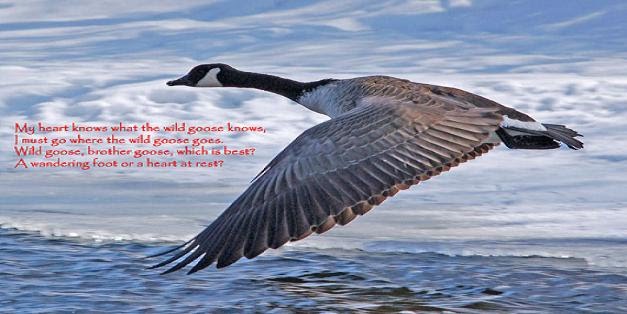
The name comes from a song Cry of the Wild Goose written in the 1940’s by singer and songwriter, Terry Gilkyson. The words described our persistent desire to roam:
My heart knows what the wild goose knows,
I must go where the wild goose goes.

Wild goose, brother goose, which is best?
A wandering foot or a heart at rest?
Let me fly, let me fly, let me fly away.
A Dream, a Plan and 20 Years of Stuff
After twenty years of accumulation, we ran newspaper ads, schlepped our furniture and belongings to the driveway for several weekend garage sales and unloaded the majority of everything we owned.
So, what it’s like moving from a relatively large home to a sailboat? Actually, it’s a bit like moving into your walk-in closet with a mini-bar attached. The living space, or cabin, is located inside the hull of the boat via a short ladder. Two tiny bedrooms have a triangular-shaped mattress for sleeping and just enough room to change clothes, if you don’t raise your arms. The bathroom, called a head because it’s the part of your anatomy consistently thwacked when using it, consists of a sink and toilet nestled together like conjoined twins. The entire room forms the shower.
Boats are a rallying force for efficiency. The kitchen, or galley, accommodates one person. There is a safety belt for attaching the cook to an adjacent bar during heavy seas although I can’t imagine why anyone wants to cook during a storm. In the center of the countertop is a hatch with a handle. It opens the refrigerated box below where desired object is always located next to the squished stick of butter on the bottom. It’s a given conclusion before you begin: you must unload the entire contents of the box before you’ll ever find what you’re looking for.
In the following blog posts, I'll tell you about the 40,000 miles we traveled on Wild Goose, about the people and the places, the storms and icebergs, whales and pirates. I’ll also tell you about other adventures we’ve tackled as this wild goose person treks around enjoying what life and the earth has to offer up. If you enjoy the blog, tell others about it. If you have comments or questions, be sure to let me know.
Cheers,
Bunny